Socratic machines
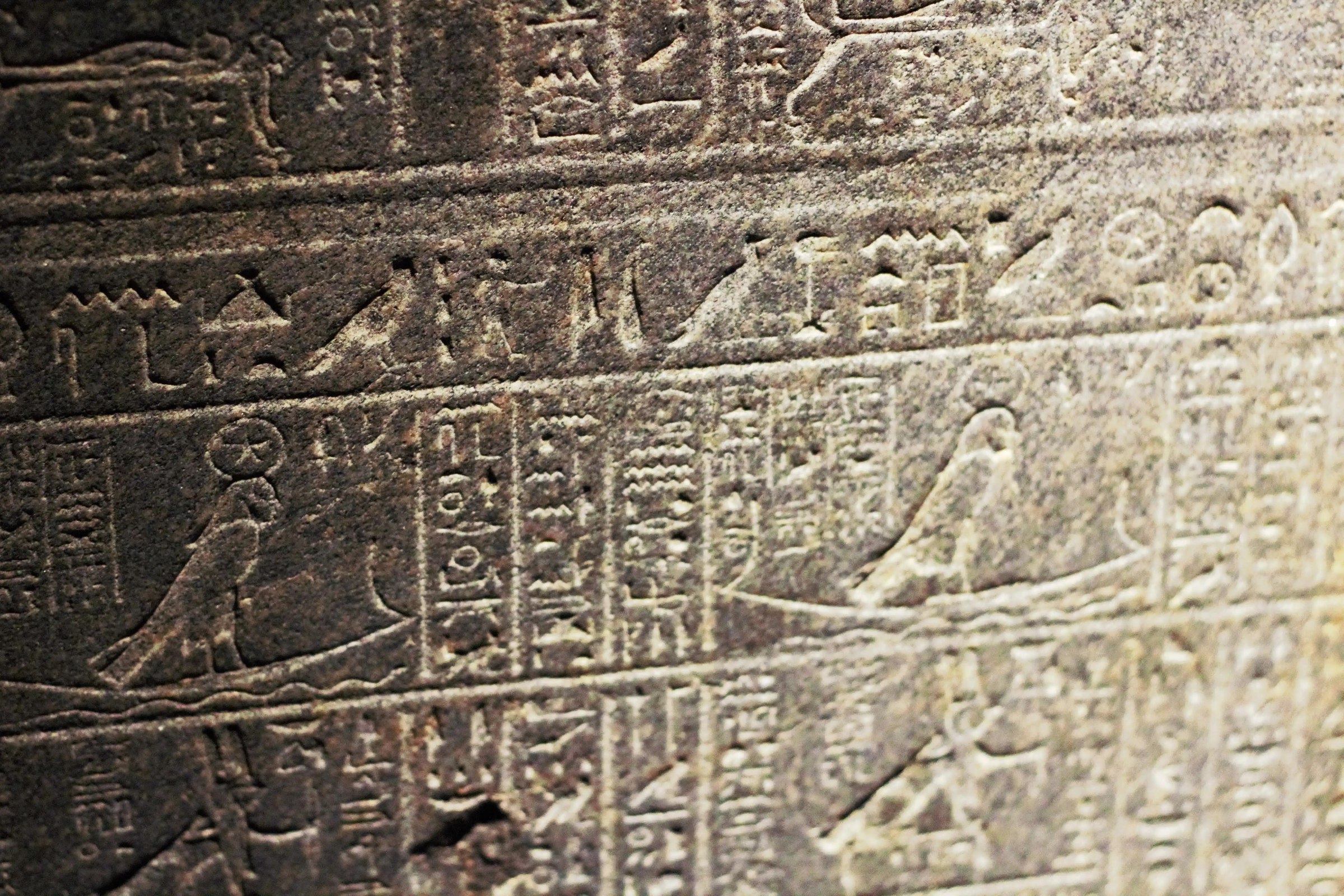
A language preserved in stone reminds us that every technology of communication shapes what can be remembered. Photo courtesy of the author.
To recover our attention, we must question how technology shapes it while acknowledging that our own habits and choices have also made us less present to one another.
One day in the early 2010s, I was with a friend at university when I encountered what I later came to think of as a “meme” machine. He was scrolling through a website filled with jokes and fragments of commentary on the news. One item followed another. He barely paused: a glance, a slight smile, then the next. I was fascinated and unsettled. How could anyone take in so many fragments so quickly? Where was the time to ask who had made them, what they meant or how they related to one another? My own impulse was to linger over each item, turning it into a question and inviting others into discussion. His attention seemed to follow a different rhythm, moving through a stream designed never to end. Information had been aggressively compressed and stripped of context, reduced to fragments that asked for recognition and reaction rather than sustained thought. From the outside, however, I could not know what he was experiencing. Perhaps he was amused, tired or simply seeking relief from a difficult day. What disturbed me was not his enjoyment of the website, but the possibility that two people could be sitting together while becoming less available to one another.
The intensity of my response puzzled me. Part of it came from the stories with which I had grown up. My grandparents had found themselves on opposing sides of civil and world wars; they endured imprisonment, internment, forced labour and the threat of death. I did not take from their lives a simple lesson about endurance. The ordinary scene before me was entirely different from their experiences in both scale and suffering. There was no direct comparison to be made. Their experiences had nevertheless left me with a question: which habits of attention allow other people to remain real to us? How do we remain answerable to one another when the systems around us encourage distance? Watching my friend made that inherited question newly present. The stream made every person and event briefly visible and immediately replaceable. What frightened me was not the machine itself, but a form of attention in which people and events were replaced before we had time to understand them, respond to them or let them matter to us. The history I had inherited from my grandparents made this form of distance feel morally charged: when people are reduced to abstractions, indifference to what happens to them becomes easier.
What frightened me was not the machine itself, but a form of attention in which people and events were replaced before we had time to understand them, respond to them or let them matter to us.
At its best, digital technology helps us cooperate. It allows us to sustain relationships across distance, organise communities, share knowledge and find support that might otherwise remain beyond reach. Yet the endless feed I had witnessed would also become the basis of a powerful business model. Applications and websites built around infinite scrolling, personalised feeds and rewards resembling those of gambling have proliferated, each making it easier to continue than to stop. I see people of all ages absorbed in the harsh glare of screens displaying gamified interfaces and unrealistic standards of beauty, often separated from those around them by headphones. Yet I cannot know what they are experiencing. They may be seeking company, distraction or simply a moment alone. I also find myself looking at the person speaking through the screen. Are they confident or insecure, joyful or exhausted? How much of a life can be conveyed through a short video, a caption and a hashtag? These platforms did not create our desire for belonging; they learned how to hold our attention through it. In Dopamine Nation, psychiatrist Anna Lembke describes a form of “disclosure porn” in which intimate revelation becomes a source of gratification rather than “a moment of shared humanity”. As recommendation systems grow more complex, even their designers may not fully anticipate what they will promote. Yet what these systems are asked to maximise remains a human choice.
In an age of hyperspecialisation, everyone contributes to the system, yet responsibility for the whole seems to belong to no one. Images, sounds and demands reach us at a scale no previous generation encountered, while the work behind them is divided into increasingly narrow tasks. Keeping everyone busy in their own corner leaves little room for context, discussion or responsibility. Some of the most capable minds of my generation have been employed to design products that capture our attention and turn our emotions into profit. As someone who has worked in technology, I cannot speak of this as somebody else’s failure. I am part of this system too. Yet condemnation is too easy. Most people are trying to support their families and see only the small part they have been asked to build. This does not absolve us; it explains how decent people can contribute to systems for which no one feels fully responsible. Responsibility is shared, but it is not equally distributed: those who set the incentives and control the systems have greater power to change them. We did not always understand what we were creating, and some designers later regretted the consequences of their work. But regret matters only if it changes what we build next.
Later, reading Modernity and the Holocaust, I found a name for part of this concern. Sociologist Zygmunt Bauman described the “social production of distance”: the way complex organisations can separate people from the moral consequences of their actions, replacing direct responsibility with procedures, specialised roles and technical decisions. His historical analysis should not be reduced to a direct comparison with digital technology. What remains relevant is the mechanism he identified. When another person disappears behind a task, a metric or a screen, it becomes easier to forget who bears the consequences of what we do.
When another person disappears behind a task, a metric or a screen, it becomes easier to forget who bears the consequences of what we do.
Distance is not only a moral condition; it also affects our health. In a 2023 advisory, physician Vivek Murthy, then US Surgeon General, described loneliness and social isolation as a public-health crisis. At the time, around half of American adults reported experiencing loneliness. Insufficient social connection is also associated with higher risks of heart disease, stroke, anxiety, depression and premature death. Technology is not the sole cause of this crisis and often helps people remain connected. Yet products designed to hold our attention can deepen the isolation they promise to relieve. Behind abstract measures of engagement are young people who may also face online compulsion, harassment, exploitation and loneliness, the consequences of which reach their families, schools and already strained healthcare systems. Because I build tools used by clinicians who treat children, I find this especially painful. In Hope for Cynics, psychologist Jamil Zaki captures the paradox: “In need of community, we are corralled back into a market, dragging us further apart.”
How, then, might we reduce the distance between us? Not by rejecting technology, but by recovering the habits it should serve: presence, attention and dialogue. To be present is more than putting a device aside. It is to become available to another person, allowing their words and circumstances to make a claim upon us. Philosopher Simone Weil understood attention as one of the purest forms of generosity because it asks us, for a moment, to set ourselves aside.
The response cannot rest upon individual willpower alone. Social worker Agustín Bonifacio reminds us that no child (and no adult) should be expected to face difficult circumstances using only their personal resources. Families, educators, clinicians, technology companies and public institutions share responsibility for creating conditions in which people can ask for help and be met with care. A familiar insight from recovery communities is that the opposite of addiction is not simply abstinence, but connection. The technologies worth building should strengthen those relationships rather than leave individuals to carry the burden alone.
Socratic dialogue gives this practice of attention a particular form: the willingness to say, “I do not know.” It treats ignorance not as a failure, but as the beginning of inquiry. Its questions are not asked to defeat another person, extract information or produce an immediate answer. They create a space in which both participants can examine their assumptions and revise what they think. In Open Socrates, philosopher Agnes Callard develops this understanding of thought as a joint inquiry, in which another person can challenge the answers we have already given ourselves. This requires moderation and proportion, timing and restraint, patience and discernment, qualities at odds with speed and constant reaction. As a child, I imagined that adulthood would depend mainly on knowledge, information and ability. I did not yet understand that some of its most difficult practices would involve attention, focus and care for oneself and others.

Thinking begins with the willingness to question what we believe we know. Photo by Andy Bodemer.
The growing capacity of artificial intelligence (AI) systems to work with language, images and code does not create an entirely new problem. For decades, digitalisation promised to save time, yet it was accompanied by expanding layers of administration, reporting, monitoring and coordination. Anthropologist David Graeber used the deliberately provocative term “bullshit jobs” for forms of employment that even the people performing them struggled to justify as useful. His criticism was not directed at those workers, whose need for income and security remained real, but at an economy capable of inventing endless tasks while essential work in care, health, education and maintenance remained undervalued, and many basic needs remained unmet. In Feeding the Machine, sociologist James Muldoon, economic geographer Mark Graham and labour researcher Callum Cant show that even technologies presented as autonomous depend upon extensive and often hidden human labour. Nor are these systems immaterial: developing and operating them requires substantial energy, water, minerals and physical infrastructure. These human and ecological costs can disappear behind the apparent ease of the interface. Wider access matters, but access alone does not distribute power, which also lies in setting a technology’s goals and incentives and in controlling the infrastructure through which it becomes available. The deeper question is whether technical progress will accelerate production or create greater shared security and more time for what sustains a common life.
This question is personal for me. When I stopped spending so much of my time on routine software coding, I felt able to raise my head again and look at the sky and the stars. More importantly, I began to notice people whose needs I had inadvertently overlooked while absorbed in my work. This did not make coding meaningless, nor did a machine teach me to care. Technology returned some time to me; how I used it remained a moral choice. Messages from clinicians who use software I built to care for their patients remind me what technology can make possible when it remains oriented towards the people it is meant to serve. In healthcare, AI should take drudgery out of care without taking the human relationship out of it. The same principle can guide us elsewhere: machines should carry tasks when doing so gives people greater freedom to attend to one another.
In a world of increasingly abundant answers, we should not compete with machines in speed or volume. It is crucial that we preserve our capacity for judgement: to question premises, tolerate uncertainty, consider consequences and decide which ends are worth pursuing. This is why the humanities remain essential. Literature, history, philosophy and the arts do not simply provide more information; they show how ideas take shape within lives, conflicts and institutions. They help us decide where to go, rather than merely how to arrive faster. The humanities also cultivate the capacity to bear witness: to recognise another person as more than a problem to solve, a pattern to identify or a source of data. This is not simply another form of information processing, but a relationship in which another life can answer us, resist us and alter our judgement.
In a world of increasingly abundant answers, we should not compete with machines in speed or volume. It is crucial that we preserve our capacity for judgement: to question premises, tolerate uncertainty, consider consequences and decide which ends are worth pursuing.
This also means resisting black-and-white accounts of technology. Using a technology compulsively and refusing to use it at all are not the same problem, but neither should prevent us from asking when a tool is useful and when it should be set aside. In Aristotelian terms, the appropriate mean is not an arithmetic midpoint between extremes, but the fitting response to a particular purpose and circumstance. Finding that measure requires us to ask: who is this tool for? Which human capacities does it strengthen? Which relationships might it displace? Does it leave us more capable of acting freely, or more dependent upon it? Judgement begins when we refuse both inevitability and panic.
Sociologist Sherry Turkle writes that “conversation is something we can forget, but also something we can remember. We can come back to each other and to ourselves.” That task has become more difficult as machines have learned to imitate conversation itself. Earlier digital technologies often interrupted human exchange; newer ones can offer to replace it. Machines can imitate the language of care, but they cannot be vulnerable, be changed by the exchange or take responsibility for its consequences. A fluent response, however convincing, is not the same as a human relationship.
A machine is not Socratic merely because it asks questions. It deserves the name only if it returns judgement to the user and knows when to withdraw. Such a machine would help users examine how their goals were formed, whom they affect and whether they are worth pursuing. It would reveal the sources, limitations and interests shaping its answers, resist flattery and preserve the user’s responsibility for judgement. The same standard should apply to the institutions that create these systems. In Nexus, historian Yuval Noah Harari argues that a wise information network is not one that never makes mistakes, but one capable of recognising and correcting them. Our technologies reflect the purposes, incentives and institutions through which we build them; their present direction is not inevitable. We can continue designing systems that capture attention and conceal their limits, or build ones that return attention, expose uncertainty and leave more room for human judgement. The machine should not become the conversation; it should help make conversation possible again.
I think back to my friend and the stream that seemed never to end. I cannot know what he found there, but I have to ask myself whether, in worrying about his inattention, I became inattentive to him. The question is therefore not only how the system might have been designed differently, but how we might have remained more available to one another within it. A differently designed system could have introduced a pause, posed a question and then withdrawn, not merely to end the interaction but to return us to the encounter already taking place beside the screen. Yet no system, however well designed, can make us attend to one another. That responsibility remains ours. The most intelligent thing a machine can do may be to remind us that the person beside us is still there.
Yet no system, however well designed, can make us attend to one another. That responsibility remains ours. The most intelligent thing a machine can do may be to remind us that the person beside us is still there.
References
- Bauman, Zygmunt. Modernity and the Holocaust. Cornell University Press, 1989.
- Bonifacio, Agustín. El plan B: Qué podemos hacer para ayudar a los jóvenes a superar su desesperanza vital. Libros Cúpula, 2025.
- Callard, Agnes. Open Socrates: The Case for a Philosophical Life. W. W. Norton & Company, 2025.
- Castro Rey, Ignacio. Antropofobia: Inteligencia artificial y crueldad calculada. Pre-Textos, 2024.
- Graeber, David. Bullshit Jobs: A Theory. Simon & Schuster, 2018.
- Harari, Yuval Noah. Nexus: A Brief History of Information Networks from the Stone Age to AI. Random House, 2024.
- Lembke, Anna. Dopamine Nation: Finding Balance in the Age of Indulgence. Dutton, 2021.
- Muldoon, James, Mark Graham and Callum Cant. Feeding the Machine: The Hidden Human Labour Powering AI. Canongate, 2024.
- Office of the U.S. Surgeon General. Our Epidemic of Loneliness and Isolation: The U.S. Surgeon General’s Advisory on the Healing Effects of Social Connection and Community. U.S. Department of Health and Human Services, 2023.
- Turkle, Sherry. Reclaiming Conversation: The Power of Talk in a Digital Age. 10th anniversary ed., Penguin Books, 2025.
- United Nations Environment Programme. Artificial Intelligence (AI) End-to-End: The Environmental Impact of the Full AI Lifecycle Needs to Be Comprehensively Assessed. 2024.
- Weil, Simone. Letter to Joë Bousquet, 13 April 1942. Quoted in Simone Pétrement, Simone Weil: A Life. Translated from the French by Raymond Rosenthal. Pantheon Books, 1976.
- Zafra, Remedios. El informe: Trabajo intelectual y tristeza burocrática. Anagrama, 2024.
- Zaki, Jamil. Hope for Cynics: The Surprising Science of Human Goodness. Grand Central Publishing, 2024.